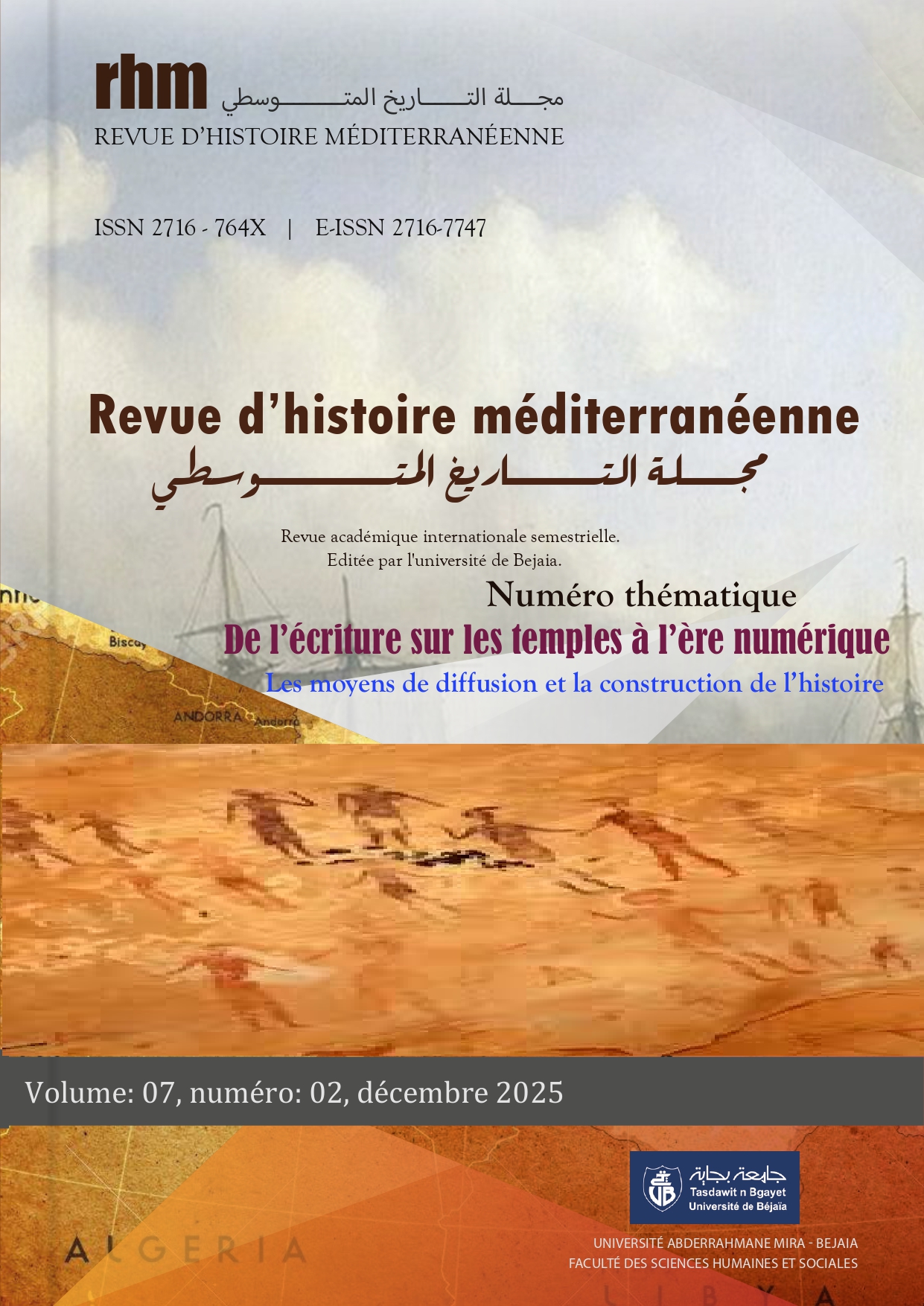
Vers une historiographie numérique : Mutations épistémologiques à l’ère de l’intelligence artificielle
Abstract
This article, situated at the intersection of History and Information and Communication Sciences, analyzes the profound impact of digitization and artificial intelligence on the construction of historical narratives. It examines the major transformations imposed by these technologies on traditional modes of producing, interpreting, disseminating, and preserving traces of the past. The main objective is to understand how history, a discipline grounded in the materiality of evidence, source criticism, and contextualization, is being reshaped by technical systems characterized by dematerialization, data volatility, automated processing, and the statistical inference power of algorithms.
The central issue concerns the ability of digital technologies to ensure the faithful and sustainable preservation of collective memory while avoiding algorithmic biases, manipulative effects, interpretative distortions, and contemporary forms of ideological rewriting encouraged by digital environments. The study thus explores the tension between the promise of universal access to knowledge and the risks of standardizing historical narratives produced by automated systems.
The methodology is based on a qualitative, critical, and multidisciplinary approach combining epistemological analysis, examination of automated data-processing technologies, and a comparative study of several empirical cases. The corpus includes, on the one hand, Saharan rock art as a model of material permanence and long-term transmission, and, on the other hand, several European digitization and heritage restoration projects (ESPADON, ARCHAIDE, RePAIR), as well as recent controversies in the field of digital humanities. The analysis also draws on major theoretical references in philosophy (Schelling, Wittgenstein), sociology of knowledge (Weber, Bourdieu), and discourse theory (Foucault).
The results show that while digital technologies